boss_notes/T-06a_OC_Test.md
7.3 KB · commit d2f3b6e
← T-05: Voltage Regulation | 🏠 Index | T-06b: SC Test →
T-06a: Open-Circuit (OC) Test
Section: A | Priority: 🔴 MUST | Exam Frequency: 7/7 years Sources: Theraja Ch-32 (Art. 32.23–32.25), VK Mehta Ch-7 (Art. 7.18–7.19), Slides L-10 S17
Why This Topic Matters
The OC/SC test is the single most certain question in the entire exam. It appeared in ALL 7 papers (2017–2024). The format is always the same: given OC and SC test data, find the equivalent circuit parameters, then calculate efficiency and/or voltage regulation. This is your guaranteed 5–10 marks if you know the procedure. The OC test finds the shunt branch parameters (Rc, Xm) and the iron loss.
📝 Key Definitions
Open-Circuit (OC) Test (No-Load Test): "The purpose of this test is to determine (i) the iron losses and (ii) no-load current I0 which is helpful in finding the parameters of the equivalent circuit — Rc and Xm. In this test, one winding of the transformer (usually the low-voltage winding) is connected to the supply at rated voltage. The other winding is left open. The input voltage, no-load current and input power are measured." — VK Mehta, Art. 7.18
Iron (core) loss (PFe): "The iron loss consists of hysteresis loss and eddy current loss. Both depend on flux density in the core. Since B∝V/f, and the supply voltage is nearly constant, iron loss is essentially constant at all loads." — From explanation notes
Test Setup and Procedure
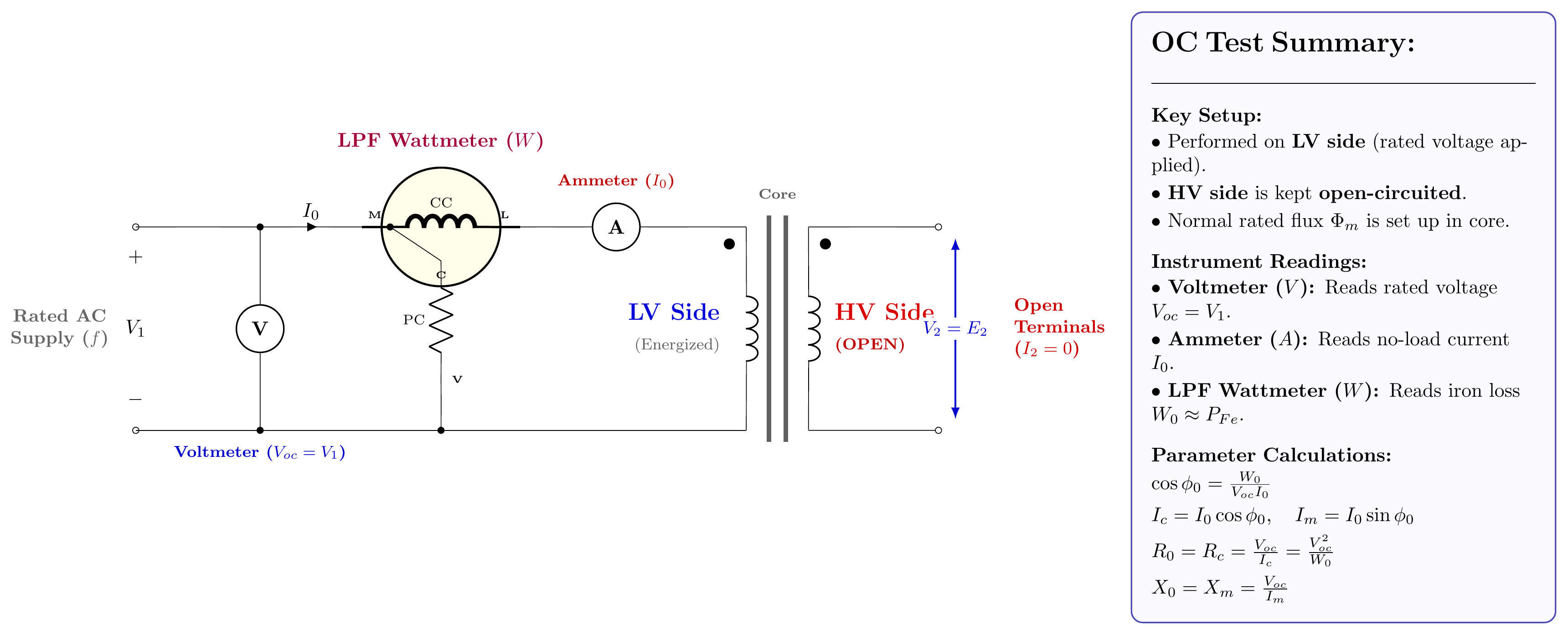
Connections (VK Mehta, Art. 7.18):
- Connect the LV winding to the rated supply voltage through a variac.
- Leave the HV winding open-circuited (no load connected).
- Connect measuring instruments on the LV side:
- Voltmeter (V0) across the winding
- Ammeter (I0) in series
- Low power factor (LPF) wattmeter (W0)
Why LV side? Two reasons:
- Rated voltage on the LV side is lower (safer, easier to supply).
- Current measuring instruments can handle the no-load current more easily.
Readings taken: V0, I0, W0 when voltage reaches rated value.
Parameter Extraction
Since the secondary is open, the only current flowing is the no-load current I0. This is small (2–10% of rated). The copper loss I02R1 is negligible.
All power input = iron loss:
PFe=W0
This iron loss is constant at all loads. It does not change whether the transformer is at no-load, half-load, or full-load.
No-load power factor:
cosϕ0=V0I0W0
Current components:
Iw=I0cosϕ0(core-loss component)
Iμ=I0sinϕ0(magnetizing component)
Shunt branch parameters (referred to the side where OC test is done):
Rc=IwV0=W0V02
Xm=IμV0
🏆 Golden Questions (Past Exam Archive)
🎯 Q1: Explain the procedure of the OC test and what parameters it determines.
Appeared: 2021 Q2(b) — 4 marks
Full Answer:
Setup: Connect the LV winding to rated supply voltage through a variac. Leave HV winding open-circuited. Place ammeter (I0), voltmeter (V0), and LPF wattmeter (W0) on the LV side.
Procedure: Gradually increase the supply voltage from zero to rated value using the variac. Record V0, I0, and W0 at rated voltage.
What it determines:
(1) Iron (core) loss: PFe=W0. The wattmeter reading directly gives the iron loss because: (a) secondary is open so I2=0 (no copper loss in secondary), and (b) the no-load current I0 is so small (2–5% of rated) that primary copper loss I02R1 is negligible.
(2) Shunt branch parameters: Rc=V02/W0 (resistance representing core loss) and Xm=V0/Iμ (magnetizing reactance).
(3) No-load current and power factor: cosϕ0=W0/(V0I0). This is typically very low (0.1–0.3).
(4) Turns ratio verification: By measuring both primary and open-circuit secondary voltages: a=V1/V2.
Why LV side? Lower voltage is safer. Current instruments can handle the small no-load current more easily.
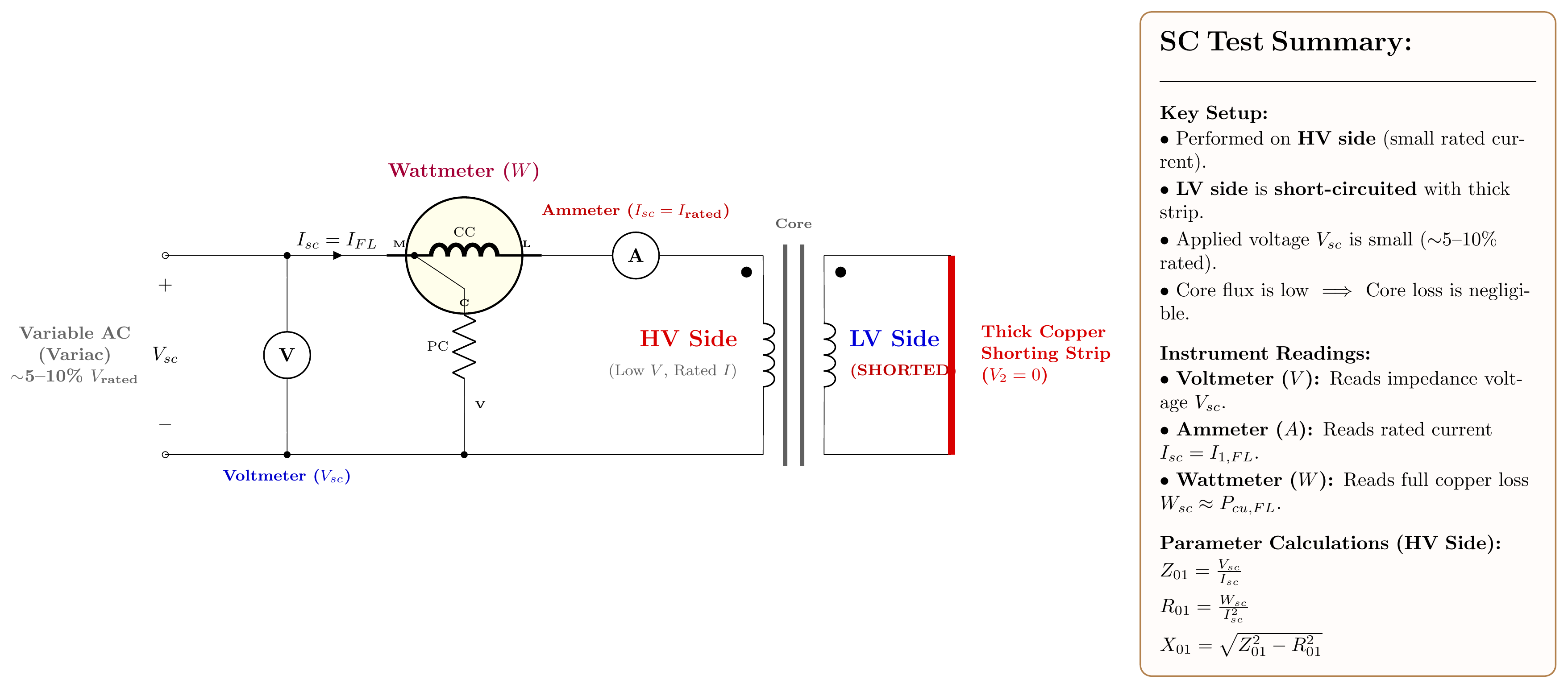
🎯 Q2: Draw circuit diagrams for OC and SC tests.
Appeared: 2020 Q2(c) — 2 marks
Full Answer:
OC Test Circuit: LV winding connected to rated AC supply through variac. Ammeter in series, voltmeter across, wattmeter measuring input. HV winding open-circuited.
SC Test Circuit: HV winding connected to variable AC supply through variac. Ammeter in series, voltmeter across, wattmeter measuring input. LV winding solidly short-circuited with a thick copper conductor.
🎯 Q3: Why are OC and SC tests preferred over direct load test?
Appeared: 2024 Q3(a) — 4 marks
Full Answer:
Testing a 500 kVA transformer by direct load test would require:
- A load bank of 500 kVA (resistors, inductors, capacitors): expensive, large, and dangerous.
- Continuous power dissipation of ~15 kW in losses per hour.
- Only one load condition at a time. Different loads require reconfiguration.
What OC and SC tests do instead:
OC test: Apply rated voltage to LV winding (HV open). Only the no-load current flows (2–5% of rated). Power consumed = iron losses only (about 0.3–0.5% of rated kVA). For a 500 kVA transformer: test power is only 1.5–2.5 kW. Tiny.
SC test: Apply 5–10% of rated voltage to HV winding (LV short-circuited). Full-load current flows but at very low voltage. Power consumed = copper losses only (about 0.8–1.5% of rated kVA). Again tiny.
From two simple, low-power tests, you get everything:
- Core loss PFe (from OC test)
- Full-load copper loss PCu,FL (from SC test)
- All four equivalent circuit parameters (Rc, Xm, R01, X01)
- Efficiency at any load and any power factor (by formula)
- Voltage regulation at any load and any power factor (by formula)
Key insight: Efficiency and VR are calculated analytically using the measured parameters. You never need to actually apply real loads. This is why OC/SC tests are universally preferred.
⚡ Exam Tips & Common Mistakes
- OC test gives iron loss, not copper loss. W0=PFe because I0 is too small for significant copper loss.
- OC test is done on LV side. Not HV. The reason is safety and convenience.
- Rc and Xm are referred to the side where the test is done. To refer to the other side, multiply by a2 (or divide, depending on direction).
- Iron loss is CONSTANT. It does not change with load.
🔗 Related Topics
- T-06b: SC Test — The companion test for series parameters
- T-06c: Efficiency — Uses PFe from OC test
- T-04: Equivalent Circuit — The circuit whose parameters we're finding
- T-03a: No-Load Operation — The physics of what happens during OC test