boss_notes/T-19_Starting_Methods_3Phase.md
5.4 KB · commit d2f3b6e
← T-18: Circle Diagram | 🏠 Index | T-20: Speed Control & Braking →
T-19: Starting Methods (3-Phase IM)
Section: B | Priority: 🟡 MEDIUM | Exam Frequency: 3/7 years Sources: Theraja Ch-34 (Art. 34.39-34.44), Slides L-06
Why This Topic Matters
Starting methods appeared in 3 out of 7 papers. The star-delta starter proof (equivalent to auto-transformer of ratio 1/3) appeared in 2018 and 2020 for 5 marks. The DOL starting limitations appeared in 2019. These are straightforward theory/proof questions worth 3-5 marks.
📝 Key Definitions
Direct-On-Line (DOL) Starting: "The simplest method of starting. The motor is directly connected to full supply voltage. Starting current is 5-8 times rated. Limited to small motors (< 5 kW)." — Theraja, Art. 34.39
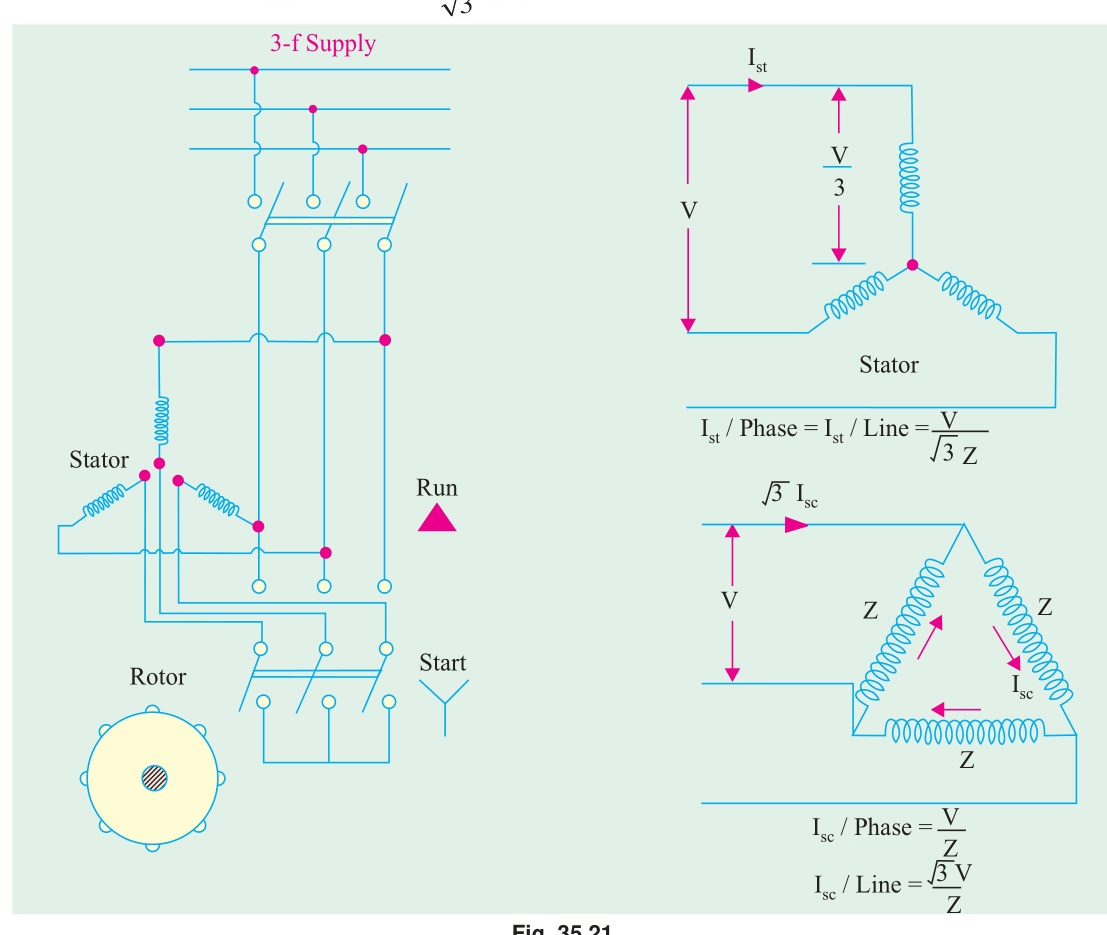
Star-Delta Starter: "The motor windings are first connected in star during starting, then switched to delta for running. Starting current and torque are reduced to 1/3 of DOL values." — Theraja, Art. 34.42
The Starting Problem
At standstill (s=1), rotor impedance is low: Z2=R22+X22. The starting current is:
Ist=(R1+R2′)2+(X1+X2′)2V≈5-8×Irated
This high current causes:
- Voltage dips in the supply affecting other loads
- High mechanical stress on shaft and couplings
- Thermal stress on windings
- Utility restrictions for motors > 5 kW
Starting Methods Summary
| Method | Current Ratio | Torque Ratio | Applications |
|---|---|---|---|
| DOL | 1 (full) | 1 (full) | Small motors < 5 kW |
| Star-Delta | 1/3 | 1/3 | Medium motors, light start |
| Auto-transformer (x) | x2 | x2 | Large motors, adjustable |
| Rotor resistance | Varies | Up to Tmax | Slip-ring motors, heavy loads |
| Soft starter | Gradual | Gradual | Smooth, electronic |
Star-Delta Starter Proof
Prove: Star-delta starter is equivalent to auto-transformer of ratio 1/3 (57.7%).
DOL starting (delta connection):
Each phase sees full line voltage VL. Per-phase starting current:
Iϕ,DOL=ZsVL
Line current: IL,DOL=3Iϕ,DOL=Zs3VL
Star-delta starting (star connection):
Each phase sees VL/3. Per-phase starting current:
Iϕ,Y=ZsVL/3=3ZsVL
Line current (star): IL,Y=Iϕ,Y=3ZsVL
Ratio:
IL,DOLIL,Y=3VL/ZsVL/(3Zs)=31
Starting current reduced to 1/3 of DOL. Starting torque also reduced to 1/3 (since T∝V2∝I2).
Auto-transformer equivalence:
For ratio x: supply current =x2IDOL. Here x2=1/3:
x=31=0.577=57.7%
Star-delta starter≡Auto-transformer of ratio 1/3=57.7%
🏆 Golden Questions (Past Exam Archive)
🎯 Q1: Prove that star-delta starter is equivalent to auto-transformer of ratio 1/3.
Appeared: 2018 Q7(a), 2020 Q7(c) — (5 marks)
Full Answer:
See Star-Delta Starter Proof above. Key results:
- DOL (delta): IL,DOL=3VL/Zs
- Star starting: IL,Y=VL/(3Zs)
- Ratio: IL,Y/IL,DOL=1/3
- Auto-transformer ratio: x2=1/3⟹x=1/3=57.7%
🎯 Q2: Effects of DOL starting for motors > 25 kW. How to minimize?
Appeared: 2019 Q7(b) — (4 marks)
Full Answer:
Effects of DOL starting:
- Starting current = 5-8 times rated. Causes voltage dips affecting other loads.
- High mechanical stress on shaft, couplings, and driven equipment.
- Thermal stress on windings. Repeated DOL starting can overheat motor.
- Utility often prohibits DOL for motors > 25 kW.
Methods to minimize:
- Star-delta starter: Starting current = 1/3 of DOL.
- Auto-transformer starter: Adjustable ratio gives flexible current/torque trade-off.
- Rotor resistance (slip-ring motor): High starting torque with reduced current.
- Soft starter: Thyristor-based gradual voltage ramp. Smooth, no current surge.
- VFD: Controls both voltage and frequency. Best control, highest cost.
Exam Variants
| Year | Question | Marks |
|---|---|---|
| 2018 Q7(a) | Y-Δ = auto-transformer proof | 5 |
| 2019 Q7(b) | DOL effects + minimization | 4 |
| 2020 Q7(c) | Y-Δ = auto-transformer proof | 5 |
⚡ Exam Tips & Common Mistakes
- Current ratio is 1/3, not 1/3. The voltage ratio is 1/3. Since I∝V for fixed impedance, and we have TWO factors (voltage AND connection change), the current ratio squares to 1/3.
- Torque also reduces to 1/3. Since T∝V2∝Iline.
- Y-Δ starter only works for motors designed to run in delta. The windings must be rated for line voltage in delta.
🔗 Related Topics
- T-15a: Starting Torque — Why high R2 helps starting
- T-20: Speed Control — Related control methods
← T-18: Circle Diagram | 🏠 Index | T-20: Speed Control & Braking →