topicwise_answers_exam_style/T-24_Single_Phasing.md
2.0 KB · commit d2f3b6e
← T-23: 1-Phase Starting Methods | 🏠 Index | T-25: Misc Induction Motor Topics →
T-24: Single Phasing
ECE 2207 — Exam-Style Answers (Sorted by Topic)
Topic Overview: This document compiles all semester final questions and exam-style answers on Single Phasing from 7 years of exams (2017–2024). Repeated questions appear once with all exam appearances noted.
[2018 Q6(a)]
📋 Appeared in: 2018 Q6(a)
(a) What is single phasing? Explain its effect on a 3-phase induction motor. [04]
Single phasing: One of the three supply phases is lost while the motor is running. This can happen due to a blown fuse, a broken supply wire, or a faulty contactor contact.
Effects on a running 3-phase motor:
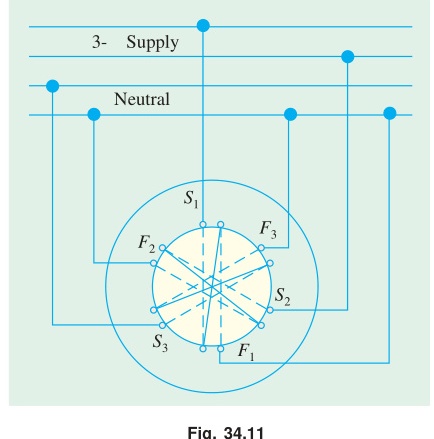
- Unbalanced supply: Only two phases now feed the stator. The magnetic field becomes pulsating and unbalanced instead of uniformly rotating.
-
Higher current in remaining phases: To maintain the same torque, current in the two active phases increases by 1.5–2 times normal. This causes overheating in the active stator windings.
-
Speed may drop: The motor can continue running (it developed enough momentum) but with reduced torque and higher slip.
-
Torque dip: The pulsating component of the magnetic field produces oscillating torque. The motor vibrates and runs noisily.
-
Motor may burn out: Sustained single-phase operation causes overheating in two windings. Without a protection relay (negative-sequence relay or thermal overload), the motor will eventually fail.
Protection: Use negative-sequence relays or single-phase preventers to detect and trip on single phasing.
← T-23: 1-Phase Starting Methods | 🏠 Index | T-25: Misc Induction Motor Topics →