boss_notes/T-20_Speed_Control_and_Braking.md
7.8 KB · commit d2f3b6e
← T-19: Starting Methods | 🏠 Index | T-21: Induction Generator →
T-20: Speed Control & Braking
Section: B | Priority: 🟡 MEDIUM | Exam Frequency: 4/7 years Sources: Theraja Ch-34-35, Slides L-07
Why This Topic Matters
Speed control and braking questions appeared in 4 out of 7 papers. Plugging was defined in 4 papers (2017, 2018, 2019, 2020). Speed control methods appeared in 2017, 2019, 2023. The rotor resistance speed control numerical appeared in 2021. These are short, definition-heavy questions worth 2-4 marks each.
📝 Key Definitions
Plugging: "A braking method in which the phase sequence of the stator supply is reversed while the motor is running. The stator field now rotates opposite to the rotor, producing a braking torque. The motor decelerates rapidly. The supply must be disconnected before zero speed, otherwise the motor reverses direction." — Theraja, Art. 34.44
Pull-out Torque: "The maximum torque a motor can develop at any operating speed. Also called breakdown torque. If the load torque exceeds pull-out torque, the motor stalls." — Theraja, Art. 34.24
Speed Control Methods
From N=Ns(1−s) and Ns=120f/P:
N=P120f(1−s)
Speed can be changed by varying f, P, or s.
1. Stator Voltage Control
Reduce supply voltage V→ reduced torque → higher slip → lower speed.
Simple but inefficient. Torque drops as V2. Only suitable for fan/pump loads (torque ∝N2).
2. Supply Frequency Control (V/f)
Change f to change Ns. Must change V proportionally to maintain constant flux (V/f = constant).
Wide, smooth speed range. Used in Variable Frequency Drives (VFDs). Best modern method.
3. Pole Changing
Switch winding configurations to change P. Gives discrete speed steps.
Example: P=4→Ns=1500 rpm; P=8→Ns=750 rpm. Only for squirrel-cage motors.
4. Rotor Resistance Control (Slip-Ring Only)
Add external resistance Rext in rotor circuit through slip rings. Higher R2→ higher slip at same torque → lower speed.
Disadvantage: Power =sPg wasted as heat in external resistors. Efficiency drops.
Electric Braking Methods
Regenerative Braking
Motor driven above Ns (s<0). Acts as induction generator. Feeds power back to supply. Energy-efficient. Only above synchronous speed.
Dynamic Braking (DC Injection)
Stator disconnected from AC. DC current fed to stator. Creates stationary field. Rotating rotor cuts this field. Braking currents induced. Energy dissipated as heat.
Plugging (Counter-Current)
Reverse two stator supply leads while running. Stator field reverses direction. Braking torque opposes motion. Very rapid deceleration. Must disconnect at zero speed. At standstill, s≈2.
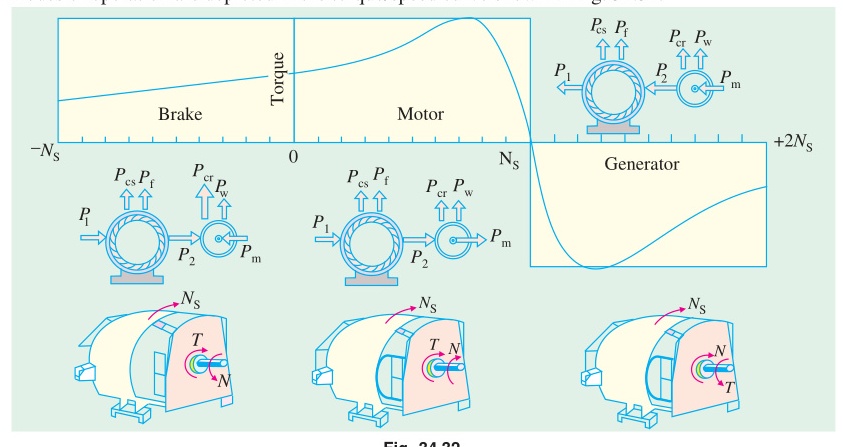
Worked Example (PYQ 2021)
2021 Q4(c): 4-pole, 50 Hz slip-ring IM. R2=0.30Ω/phase, runs at 1440 rpm full load. Find external resistance to lower speed to 1320 rpm at same torque.
Ns=120×50/4=1500 rpm
Full-load slip: s1=(1500−1440)/1500=0.04
New slip: s2=(1500−1320)/1500=0.12
Constant torque condition (low-slip approximation):
R2s1=R2+Rexts2
0.300.04=0.30+Rext0.12
0.30+Rext=0.040.12×0.30=0.90Ω
Rext=0.90−0.30=0.60Ω/phase
🏆 Golden Questions (Past Exam Archive)
🎯 Q1: Define plugging and pull-out torque.
Appeared: 2017 Q2(a) — (2 marks)
Full Answer:
Plugging: A braking method. The phase sequence of stator supply is reversed while the motor runs. A braking torque opposes rotation. Motor decelerates rapidly. Supply must be cut at zero speed or the motor reverses.
Pull-out torque: The maximum torque a motor can develop. Also called breakdown torque (Tmax). If load exceeds this, the motor stalls.
🎯 Q2: Short notes on regenerative braking, dynamic braking, and plugging.
Appeared: 2018 Q5(a) — (3 marks)
Full Answer:
(i) Regenerative braking: Motor speed exceeds Ns (s<0). Machine acts as generator. Power fed back to supply. Smooth, efficient. Used in cranes (lowering loads) and electric trains.
(ii) Dynamic braking: Stator disconnected from AC supply. DC fed to stator winding. Stationary magnetic field created. Rotating rotor cuts this field and braking currents are induced. Energy dissipated as heat in rotor.
(iii) Plugging: Two stator leads swapped while running. Stator field reverses. Braking torque opposes motion. Very rapid stop. Must disconnect at zero speed.
🎯 Q3: Mention speed control methods and discuss any one.
Appeared: 2017 Q2(c) — (4 marks)
Full Answer:
Speed control methods: (1) Stator voltage control, (2) Supply frequency control (V/f), (3) Pole changing, (4) Rotor resistance control.
Rotor resistance control: For slip-ring motors only. External resistance added through slip rings. From T∝sV2/Rtotal (at low slip), for constant torque: s∝Rtotal. Higher resistance = higher slip = lower speed.
Disadvantage: Power sPg wasted as heat. Efficiency drops. Used where step-speed control and high starting torque are needed (cranes, hoists).
🎯 Q4: Rotor resistance numerical for speed reduction.
Appeared: 2021 Q4(c) — (4 marks)
Full Answer:
See Worked Example above. Result: Rext=0.60Ω/phase.
🎯 Q5: Define braking of IM. How can speed be controlled?
Appeared: 2019 Q7(c) — (4 marks)
Full Answer:
Braking: Applying a decelerating torque to bring the motor to rest or control speed. Three methods: plugging, dynamic braking, regenerative braking.
Speed control methods:
- Stator voltage control: Reduce V, torque drops, speed drops. Simple but poor efficiency.
- V/f control: Change both V and f proportionally. Wide smooth range. VFDs.
- Pole changing: Switch winding configuration. Discrete speed steps. Squirrel-cage only.
- Rotor resistance: Add external R (slip-ring). Higher slip = lower speed. Lossy.
- Slip energy recovery: Feed slip power back to supply instead of wasting. Efficient but complex.
Exam Variants
| Year | Question | Marks | Focus |
|---|---|---|---|
| 2017 Q2(a) | Define plugging + pull-out torque | 2 | Definitions |
| 2017 Q2(c) | Speed control methods + discuss one | 4 | Theory |
| 2018 Q5(a) | Three types of braking | 3 | Short notes |
| 2019 Q7(c) | Define braking + speed control | 4 | Theory |
| 2020 Q8(a) | Define plugging + slip | 2 | Definitions |
| 2021 Q4(c) | Rotor resistance numerical | 4 | Numerical |
⚡ Exam Tips & Common Mistakes
- Plugging appears in almost every paper. Memorize a 3-sentence definition.
- Rotor resistance method ONLY works for slip-ring motors. Squirrel-cage has no access to rotor.
- In the speed control numerical: The key equation is s1/R2=s2/(R2+Rext) for constant torque.
- Don't confuse regenerative braking with plugging. Regenerative = above Ns, power flows back. Plugging = phase reversal, no power recovery.
🔗 Related Topics
- T-15c: Torque-Speed Curves — Braking regions on the curve
- T-19: Starting Methods — Related to starting current
- T-21: Induction Generator — Regenerative braking = generator mode
← T-19: Starting Methods | 🏠 Index | T-21: Induction Generator →