boss_notes/T-10_Auto_Transformer.md
6.8 KB · commit d2f3b6e
← T-09: Vector Groups | 🏠 Index | T-11: Miscellaneous →
T-10: Auto-Transformer
Section: A | Priority: 🟡 MEDIUM | Exam Frequency: 3/7 years Sources: Theraja Ch-32 (Art. 32.37–32.40), VK Mehta Ch-7 (Art. 7.25–7.27), Slides L-11 S32
Why This Topic Matters
The auto-transformer appeared in 3/7 papers (2020 three times). When it appears, it carries 3-4 marks per sub-question. The three standard question types are: (1) compare with 2-winding transformer, (2) prove copper saving = (1−K), (3) list applications. The 2020 paper devoted 10 marks to auto-transformers alone.
📝 Key Definitions
Auto-transformer: "An auto-transformer is a transformer with one winding only, part of the winding being common to both primary and secondary. Obviously, in an auto-transformer, the primary and secondary are not electrically isolated from each other as is the case with a 2-winding transformer. However, its theory and operation are similar to those of a two-winding transformer." — VK Mehta, Art. 7.25
Transformation ratio (K): "K=V2/V1=N2/N1. For step-down: K<1. The closer K is to 1, the greater the copper saving." — VK Mehta
How an Auto-Transformer Works
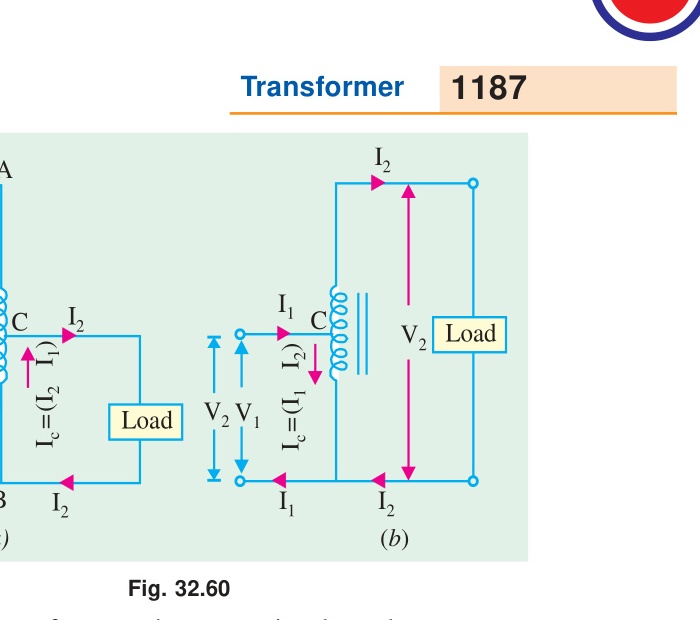
In a regular 2-winding transformer, primary and secondary are electrically isolated. In an auto-transformer, there is no isolation. The secondary is part of the primary winding.
Step-down auto-transformer: The full winding (N1 turns) connects to the supply. A tap at N2 turns provides the output. Current in the common section is (I2−I1), which is smaller than I2.
Comparison with Two-Winding Transformer
| Feature | Two-Winding | Auto-Transformer |
|---|---|---|
| Windings | Two separate, isolated | Single winding with tap |
| Electrical isolation | Yes | No |
| Copper required | More | Less (saving = 1−K) |
| Efficiency | Slightly lower | Higher (direct conduction) |
| Size and weight | Larger | Smaller, lighter |
| Cost | Higher | Lower |
| Voltage ratio | Any ratio practical | Best for close ratios (K≈1) |
| Short-circuit current | Limited by leakage | Higher (less impedance) |
🏆 Golden Questions (Past Exam Archive)
🎯 Q1: Compare two-winding transformer and auto-transformer.
Appeared: 2020 Q2(a) — 3 marks
Full Answer:
| Feature | Two-Winding Transformer | Auto-Transformer |
|---|---|---|
| Construction | Two separate, electrically isolated windings wound on a common core | Single winding with a tapping point, part common to both primary and secondary |
| Electrical isolation | Complete galvanic isolation between primary and secondary | No isolation. Primary and secondary are electrically connected. A fault on one side affects the other. |
| Copper requirement | Higher. Both windings need full copper for their respective currents. | Lower. Copper saving = (1−K) fraction. For close ratios (K≈1), the saving is huge. |
| Efficiency | Slightly lower. All power transfers magnetically. | Higher. Part of the power transfers by direct electrical conduction (not through the magnetic field), reducing losses. |
| Size and weight | Larger (more copper, more core) | Smaller and lighter for the same VA rating |
| Cost | Higher | Lower |
| Suitable voltage ratio | Any ratio, including very high step-up/step-down | Best for close ratios (K>0.5). At extreme ratios, the lack of isolation becomes a safety concern. |
| Short-circuit current | Limited by leakage impedance | Higher than a 2-winding transformer (less leakage). Protection must be more robust. |
| Applications | Power transmission (isolation needed), distribution | Motor starting (reduced voltage), variacs, inter-ties between close-voltage power systems |
🎯 Q2: Prove: copper saved in auto-transformer = (1−K) times that of an ordinary transformer.
Appeared: 2020 Q2(b), 2020 Q3(b) — 4 marks
Full Answer:
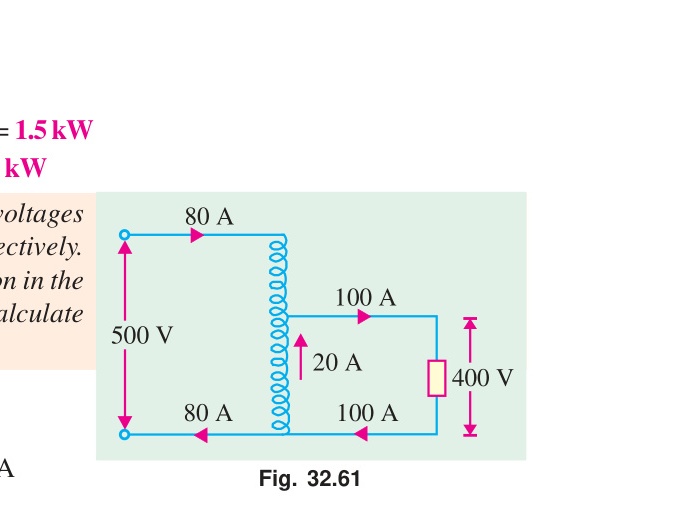
For a two-winding transformer of rated S=VI: copper is proportional to total ampere-turns in both windings.
W2-winding∝N1I1+N2I2
Since N1I1=N2I2 (approximately):
W2-winding∝2N1I1
For an auto-transformer with step-down ratio K=N2/N1<1:
- Series section (N1−N2 turns) carries current I1
- Common section (N2 turns) carries current (I2−I1)
Copper in auto-transformer:
Wauto∝(N1−N2)I1+N2(I2−I1)
Since N1I1=N2I2: we can write N2I2=N1I1
Wauto∝N1I1−N2I1+N2I2−N2I1=N1I1−2N2I1+N1I1=2I1(N1−N2)
Ratio:
W2-windingWauto=2N1I12I1(N1−N2)=1−N1N2=1−K
Therefore: Copper in auto-transformer = (1−K) × copper in ordinary transformer.
Copper saving=K×Wordinary
Example: For K=0.9 (10% step-down): auto-transformer uses only (1−0.9)=10% of the copper. Saves 90%. For K=0.5 (50% step-down): saves only 50%.
🎯 Q3: Fields of application of auto-transformer.
Appeared: 2020 Q4(a) — 3 marks
Full Answer:
- Starting of induction motors (auto-transformer starter): Provides reduced voltage during starting to limit starting current, then switches to full voltage at running speed.
- Laboratory variacs (variable AC supply): A continuously variable auto-transformer provides any voltage from 0 to rated (and often above rated) for testing.
- Power transmission inter-ties: Close-voltage-ratio interconnections between two power systems (e.g., 400 kV / 345 kV). The small voltage difference means large copper savings.
- Railway traction: Voltage boosters along the track (25 kV / 12.5 kV).
- Voltage stabilizers: Automatic voltage regulators for consumer supply.
- Fluorescent lamp ballasts and dimmers: Voltage adjustment for lighting circuits.
⚡ Exam Tips & Common Mistakes
- No electrical isolation. This is the main disadvantage.
- Copper saving = K, not (1−K). The auto-transformer USES (1−K) fraction of copper. It SAVES K fraction.
- Best for close ratios. When K≈1, savings are enormous.
🔗 Related Topics
- T-01: Fundamentals — Basic transformer principle
- T-11: Miscellaneous — Other special transformer topics