boss_notes/T-09_Vector_Groups.md
6.8 KB · commit d2f3b6e
← T-08: Scott Connection | 🏠 Index | T-10: Auto-Transformer →
T-09: Vector Groups & Parallel Operation
Section: A | Priority: 🟡 MEDIUM | Exam Frequency: 4/7 years Sources: Theraja Ch-33 (Art. 33.11–33.14), VK Mehta Ch-7 (Art. 7.34–7.35), Slides L-11 S25–S30
Why This Topic Matters
Vector group notation was asked in 3/7 papers (2019, 2021, 2023). Parallel operation conditions appeared in 3/7 papers (2017, 2021, 2023). These are short-answer theory questions worth 3-4 marks each.
📝 Key Definitions
Vector group: "A standardized notation (IEC) that describes the connection of the windings and the phase displacement between the primary and secondary voltages of a three-phase transformer. The notation consists of: an uppercase letter for the HV winding connection (Y, D, or Z), a lowercase letter for the LV winding connection (y, d, or z), optionally 'n' for neutral availability, and a clock number indicating the phase displacement (each hour = 30°)." — Theraja, Ch-33
Parallel operation of transformers: "Two or more transformers are said to operate in parallel when their primaries are connected to the same supply buses and their secondaries feed a common load. For satisfactory parallel operation, several conditions must be fulfilled." — VK Mehta, Art. 7.34
Reading Vector Group Notation
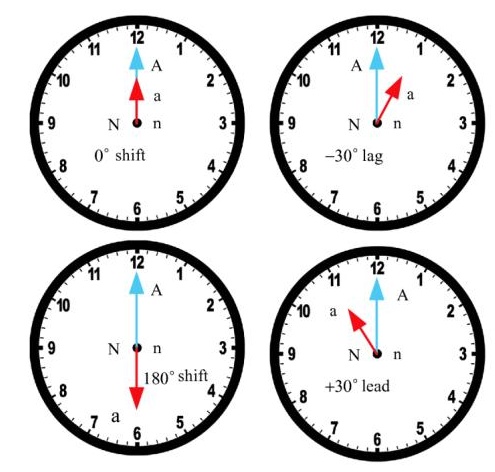
Example: Dyn11
| Symbol | Meaning |
|---|---|
| D | HV (primary) winding: Delta |
| y | LV (secondary) winding: Star (Y) |
| n | Neutral conductor available on LV side |
| 11 | Phase displacement = 11 × 30° = 330° = -30° |
The "11" means: if the HV voltage phasor points to 12 o'clock, the LV voltage phasor points to 11 o'clock.
Conditions for Parallel Operation
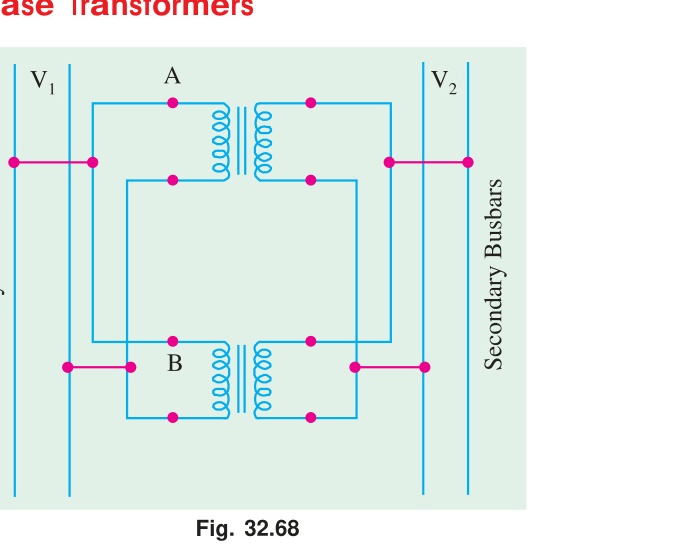
Five Conditions:
- Same voltage ratio. Otherwise circulating current flows at no-load.
- Same polarity. Reversed polarity causes short-circuit.
- Same phase sequence. Reversed sequence creates phase difference.
- Same vector group (zero phase displacement). Mismatched groups cause large circulating currents.
- Same per-unit impedance. Otherwise load sharing is disproportionate.
🏆 Golden Questions (Past Exam Archive)
🎯 Q1: What does the vector group of a transformer indicate? What does "Dyn5" represent?
Appeared: 2021 Q8(b) — 3 marks
Full Answer:
Vector group is a standardized notation that tells you:
- The connection of the primary (HV) winding: uppercase letter (Y = Star, D = Delta, Z = Zigzag).
- The connection of the secondary (LV) winding: lowercase letter (y, d, z).
- Whether a neutral is available on the LV side: letter 'n'.
- The phase displacement between primary and secondary voltages: clock notation (number × 30°).
"Dyn5" means:
- D → Primary winding connected in Delta (Δ)
- y → Secondary winding connected in Star (Y)
- n → Neutral conductor available on the secondary side
- 5 → Phase displacement = 5 × 30° = 150° (secondary voltage lags primary by 150°)
In clock notation: 12 o'clock = 0°, 1 o'clock = 30°, 5 o'clock = 150°. So Dyn5 means the secondary star voltage phasor points to "5 o'clock" relative to the primary delta voltage phasor at "12 o'clock."
🎯 Q2: State the conditions for parallel operation of two 3-phase transformers.
Appeared: 2017 Q7(b), 2021 Q4(a), 2023 Q4(b) — (3-4 marks)
Full Answer:
For satisfactory parallel operation of two (or more) 3-phase transformers, all five of the following conditions must be satisfied:
(1) Same voltage ratio: The primary and secondary rated voltages must be identical. If voltage ratios differ, a circulating current flows in the secondary loop even at no load. This circulating current wastes energy and may overload one transformer.
(2) Same polarity: Corresponding terminals must have the same instantaneous polarity. If polarity is reversed, the two secondary voltages add instead of cancelling, causing a short-circuit current of enormous magnitude.
(3) Same phase sequence: Both transformers must be connected to the same phase sequence (R-Y-B). A reversed sequence causes a large phase difference between secondary voltages.
(4) Same vector group (zero phase displacement): The vector group numbers must be the same. If the phase displacements differ (e.g., one is Yd11 and the other is Dy1), the secondary voltages will have a phase difference, causing circulating currents even at no load.
(5) Same per-unit (or percentage) impedance: For proportional load sharing, the per-unit impedances must be equal. If one transformer has lower impedance, it takes a disproportionately large share of the load and may overload while the other runs light.
🎯 Q3: Can Yd11 operate in parallel with Dy1?
Appeared: 2019 Q3(c) — 4 marks
Full Answer:
Vector group numbers:
- Yd11: Phase displacement = 11 × 30° = 330° (equivalent to -30°). Secondary lags primary by 30°.
- Dy1: Phase displacement = 1 × 30° = 30°. Secondary leads primary by 30°.
Phase difference between their secondaries:
330°−30°=300°(or equivalently 360°−300°=60° lag)
This is a 60° phase displacement between the secondary voltages of the two transformers.
For parallel operation, the secondary voltages must be exactly in phase (same vector group number). A 60° difference means that even at no load, a very large circulating current would flow: Icirc=ΔV/(Z1+Z2) where ΔV is the phasor difference of the two secondary voltages. For 60° displacement, ΔV is approximately equal to the rated voltage itself.
Conclusion: Direct parallel operation is NOT possible. The vector groups are incompatible.
A phase-shifting transformer or rearranging external connections can sometimes compensate for a 30° difference, but a 60° difference is generally not bridgeable by simple reconnection.
⚡ Exam Tips & Common Mistakes
- Clock number × 30° = phase displacement. Don't forget the multiplication.
- Uppercase = HV side, lowercase = LV side.
- For parallel operation, ALL 5 conditions must be satisfied.
- Same group number, not same group family. Yy0 can parallel with Dd0, but Yd11 cannot parallel with Dy1.
🔗 Related Topics
- T-07a: 3-Phase Connections — The connections that create different vector groups
- T-07b: Open Delta — Special case of Δ-Δ
← T-08: Scott Connection | 🏠 Index | T-10: Auto-Transformer →