SlidesByMaam/L-04_ECE-2107.md
9.2 KB · commit d2f3b6e
Electrical Machines-I
ECE-2107
Induction Motor-SL3
Fariya Tabassum
Assistant Professor, Dept. of Electrical & Computer Engineering
Rajshahi University of Engineering & Technology, Rajshahi-6204
“Allah does not burden a soul beyond that it can bear”.
[Sura Baqarah]
Rotor Torque
The torque T developed by the rotor is directly proportional to
- Rotor current
- Rotor e.m.f
- Power factor of the rotor circuit
∴T∝E2I2cosφ2
Or T=KE2I2cosφ2
Where,
I2= Rotor current at standstill
E2= Rotor e.m.f at standstill
cosφ2= Rotor power factor at standstill
Starting Torque
The torque developed by the motor at the time of starting is known as starting torque of the motor.
Let, E2= rotor e.m.f. per phase at standstill
R2= rotor resistance per phase
X2= rotor reactance per phase at standstill
Z2=(R22+X22)=rotor impedance per phase at standstill
Then, rotor current I2=Z2E2=(R22+X22)E2
power factor cosφ2=Z2R2=(R22+X22)R2
Now, the starting torque Tst=K1E2I2cosφ2
or Tst=K1E2(R22+X22)E2(R22+X22)R2=K1R22+X22E22R2
Starting Torque
If the supply voltage is constant, then the flux φ and hence E2 both are constant.
∴Tst=K2R22+X22R2=Z22K2R2
It can be shown that, K1=2πNs3
∴Tst=2πNs3R22+X22E22R2
Where, Ns= Synchronous speed in r.p.s
For preparing your answer you can go through the article 34.13 of the book written by “B. L. Theraza”
Condition for Maximum Starting Torque
It can be proved that starting torque will be maximum when rotor resistance/phase is equal to standstill rotor reactance/phase.
We know the staring torque, Tst=K2R22+X22R2(i)
Differentiating equation (i) w.r.t R2 and equating the result to zero we get,
dR2dTst=K2[R22+X221−(R22+X22)2R2(2R2)]=0
Or R22+X22=2R22
∴R2=X2
Problems
Practice example 34.6, 34.7, 34.8, 34.9 and 34.11 of B. L. Theraza and also the related tutorial problem.
Torque Under Running Conditions
Let the rotor at standstill have per phase induced e.m.f. E2, reactance X2 and resistance R2. Then under running conditions at slip s
Rotor e.m.f per phase Er=sE2
Rotor reactance per phase Xr=sX2
Rotor impedance per phase Zr=(R22+(sX2)2)
Rotor current per phase Ir=ZrEr=(R22+(sX2)2)sE2
power factor cosφr=ZrR2=(R22+(sX2)2)R2
Torque Under Running Conditions
Then, running torque Tr∝ErIrcosφr
Tr∝φIrcosφr
∝φ(R22+(sX2)2)sE2(R22+(sX2)2)R2
∝φR22+(sX2)2sE2R2
=KφR22+(sX2)2sE2R2
=R22+(sX2)2K1sE22R2
If the stator supply voltage is constant, then stator flux and hence E2 will be constant.
Torque Under Running Conditions
∴Tr=R22+(sX2)2K2sR2
Where, K2 is another constant.
It may be seen that running torque is
- Directly proportional to the slip i.e., if slip increases (motor speed decreases), the torque will increase and vice-versa.
- Directly proportional to square of supply voltage (*)**
Torque Under Running Conditions
It can be shown that, K1=2πNs3
Where, Ns= Synchronous speed in r.p.s
∴Tr=2πNs3R22+(sX2)2sE22R2=2πNs3Zr2sE22R2
At standstill, when s=1, Tr=R22+(sX2)2K1E22R2(or =2πNs3R22+(sX2)2E22R2)
Same as the starting torque.
Condition for Maximum Torque Under Running Conditions
The torque of a rotor under running condition is
Tr=KφR22+(sX2)2sE2R2=R22+(sX2)2K1sE22R2
The condition for maximum torque may be obtained by differentiating the above expression w.r.t to slip, s and then putting it equal to zero. However, it is simpler to put Y=Tr1 and then differentiate it.
∴Y=KφsE2R2R22+(sX2)2=KφsE2R2+KφE2R2sX22
∴dsdY=Kφs2E2−R2+KφE2R2X22=0
∴Kφs2E2R2=KφE2R2X22 or R22=s2X22 or R2=sX2
Condition for Maximum Torque Under Running Conditions
Hence torque under running condition is maximum at that slip which makes rotor reactance per phase equal to rotor resistance per phase. This slip is sometimes written as sb and the maximum torque as Tb.
The slip corresponding to maximum torque is s=R2/X2
After putting R2=sX2 in the expression of torque, we get
Tmax=2s2X22Kφs2E2X2(or 2R22KφsE2R2)
Or Tmax=2X2KφE2(or 2R22KφsE2)
Condition for Maximum Torque Under Running Conditions
Substituting value of s=R2/X2 in another expression of torque, we get
Tmax=K1R22+(R2/X2)2X22(R2/X2)E22R2=K12X2E22
Since K1=2πNs3, we have Tmax=2πNs32X2E22 N-m
It is evident from the above expression that,
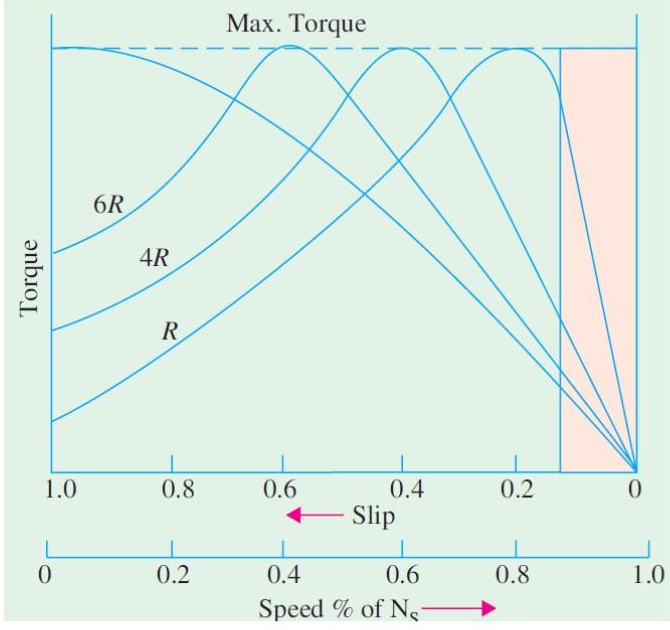
- The value of rotor resistance does not alter the value of the maximum torque but only the value of slip at which it occurs.
- The maximum torque varies inversely as the standstill reactance. Therefore it should be kept as small as possible.
- The maximum torque varies directly with the square of the applied voltage .
- To obtain maximum torque at starting, the rotor resistance must be made equal to rotor reactance at standstill.
Torque-slip characteristics
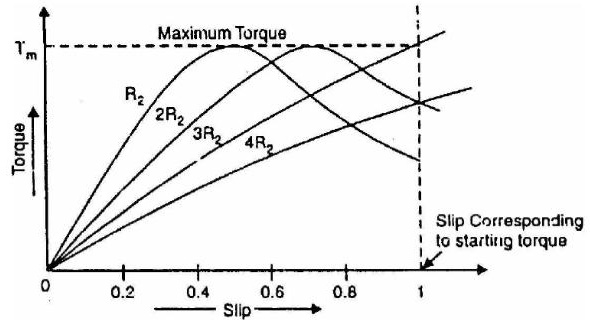
If a curve is drawn between the torque and slip for a particular value of rotor resistance R2, the graph thus obtained is called torque-slip characteristic.
It shows a family of torque-slip characteristics for a slip-range from s = 0 to s = 1 for various values of rotor resistance.
We know that torque, T=R22+(sX2)2KφsE2R2
The following points may be noted carefully
- At s = 0, T = 0 so that torque-slip curve starts from the origin.
- At normal speed, slip is small so that sX2 is negligible as compared to R2.
∴T∝s/R2 ∝s[as R2 is constant]
Hence torque slip curve is a straight line from zero slip to a slip that corresponds to full-load.
Torque-slip characteristics
As slip increases beyond full-load slip, the torque increases and becomes maximum at s=R2/X2. This maximum torque in an induction motor is called pull-out torque or break down torque.
- As the slip further increases (i.e. motor speed falls) with further increase in motor load, then R2 becomes negligible as compared to sX2 Therefore, for large values of slip
T∝(sX2)2s∝s1
Thus the torque is now inversely proportional to slip. Hence torque-slip curve is a rectangular hyperbola.
- The maximum torque remains the same and is independent of the value of rotor resistance. Therefore, the addition of resistance to the rotor circuit does not change the value of maximum torque but it only changes the value of slip at which maximum torque occurs.
Torque-speed characteristics